The Hiring Didn’t Stop. It Got Quiet.
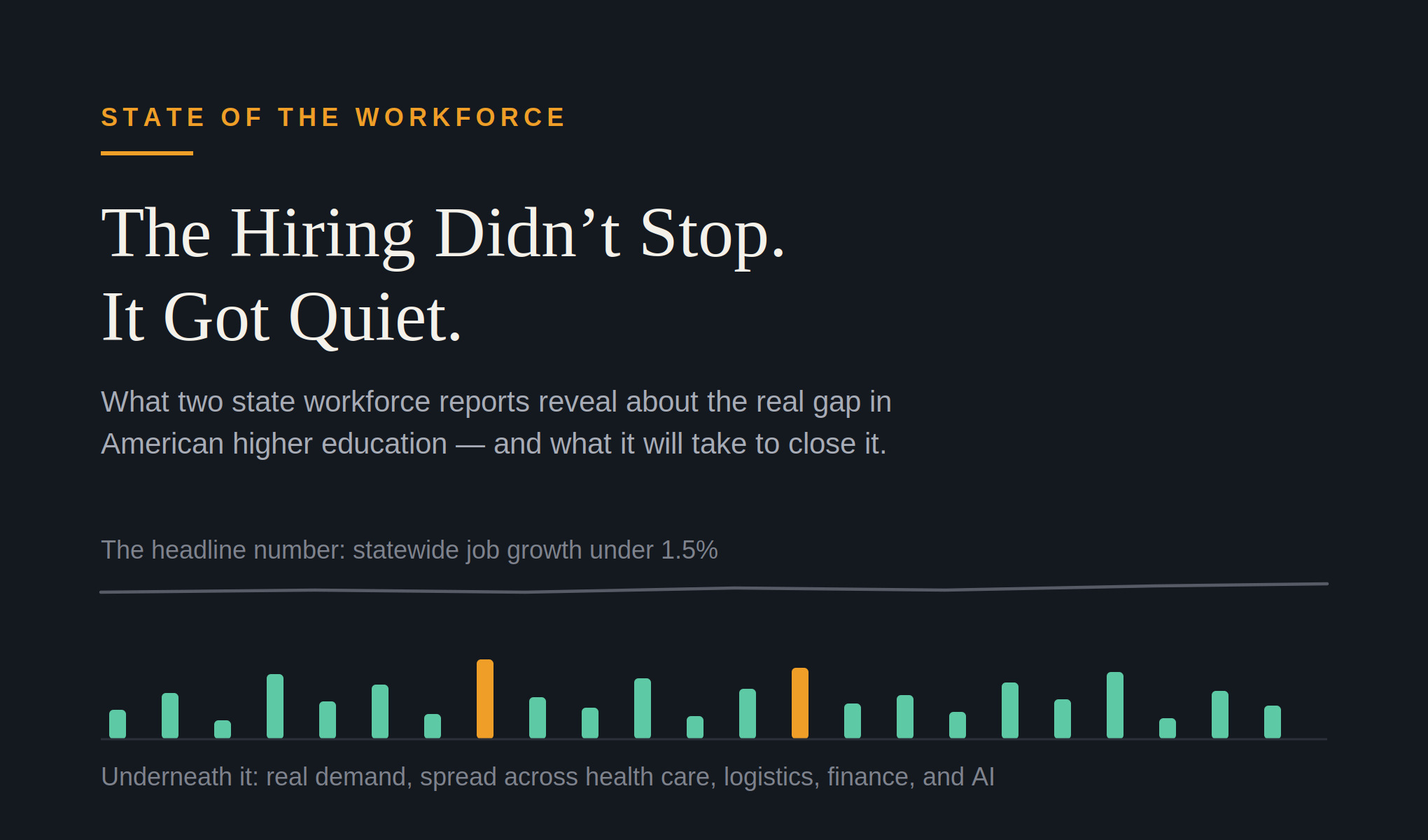
What two state workforce reports reveal about the real gap in American higher education—and what it will take to close it.
Clayton Dean is the Vice President of Partnerships and Growth at Ziplines Education, managing over 35 university partners and driving growth in new university and B2B revenue. With over 15 years as an EdTech operator, he previously co-founded Circa Interactive, an enrollment marketing firm serving 75+ colleges and universities.
For most of the past two years, the dominant story about the labor market has been that it’s been cooling. Hiring slowed, layoff announcements filled the headlines, and the prevailing advice to anyone making long-term plans has been to wait for a clearer signal. If you lead a university’s continuing education or workforce division, you have almost certainly felt conflicted —the reasonable instinct to hold off on building anything new until the workforce stabilizes.
However, despite what the headlines read, the picture is actually quite the opposite. Hiring hasn’t stopped over the past two years. It got quiet. It became distributed—spread thin across industries and regions instead of concentrated in a few visible sectors—and quiet, distributed demand is easy to miss. That is precisely why it deserves a closer look from the institutions whose job is to prepare people for it.
Two States, One Pattern
Over the past year, our team at Ziplines published two State of the Workforce reports: one on New York, anchored by one of the country’s densest urban financial economies, and one on Illinois, a Midwestern logistics and manufacturing hub centered on Chicago. We expected two very different economies to produce two very different stories. They produced one.
New York’s total employment grew 1.4 percent between 2019 and 2024. Illinois grew 0.6 percent. Both fell well short of the national rate of 4.4 percent. Taken at face value, figures like those look like stagnation. But in both states, a closer reading of the very same data revealed something the headline number could not: real, sustained hiring demand, distributed quietly across industries, and moving faster than the institutions built to serve it.
That consistency is itself the finding. A single state showing this pattern could be dismissed as a local anomaly. But New York and Illinois have almost nothing economically in common; they still produced similar signals, and it suggests more of a structural challenge than a local one.
The Headline Number Is the Wrong Signal
Consider the number an institutional leader sees first. A statewide job-growth rate well under one percent argues, almost on its own, against action. If the labor market is barely growing, why invest in new programs? But a single statewide growth rate is a blunt instrument. It records the net result of hundreds of separate industry stories—some contracting, others expanding—and reports only the balance between them.
Look beneath it, and the picture changes sharply. In Illinois, that 0.6 percent masks a health care sector that grew 7 percent since 2019 to nearly 900,000 jobs, and a logistics sector up 9 percent, now exceeding 350,000 jobs as the state cements its position as a national distribution hub. In New York, the same exercise surfaces a health care and social assistance sector that has reached roughly 1.9 million jobs—already the state’s largest employer and still expanding—alongside a transportation and warehousing sector that grew by nearly a third in five years. The economy underneath the headline is not stagnant. It is reorganizing. A single aggregate figure is built, almost by definition, to hide exactly that.
Quiet Demand Is Still Demand
What makes this reorganization so easy to overlook is its shape. When hiring concentrates in one visible sector, it announces itself, and institutions know where to build in response. When demand is distributed instead—a steady stream of openings across health care, logistics, finance, administration, and sales all at once—no single number ever grows loud enough to become news. The hiring is just as real. It simply never arrives as a headline.
For a university leader, that distributed pattern should not read as a complication. It should read as an opportunity, and a relatively durable one. Demand across many industries is not tied to the fortunes of a single employer or the volatility of a single sector. It is broad, and demand tends to be more stable.
It also reshapes the question of what is worth building, because the capabilities employers most consistently ask for are not narrowly sector specific. They are the ones that travel. In Illinois, job postings show demand for marketing roles running about 22 percent above the national average and project management roles about 15 percent above—and those skills appear across health care, manufacturing, logistics, and finance alike. In New York, finance and accounting roles run more than 45 percent above the national average, while nursing remains the single most in-demand skill statewide. A well-designed credential in skills like these does not serve a single employer or industry. It serves learners across the whole economy at once.
And across both states, the fastest-moving signal is artificial intelligence. In Illinois alone, mentions of AI-related skills in job postings rose 974 percent between 2023 and 2025. That is a single state’s reading, but it tracks the national picture: Lightcast’s 2025 analysis of more than a billion job postings found that demand for AI skills is now growing fastest outside of technology roles—in marketing, human resources, and finance. AI is no longer a specialization. It is becoming a baseline expectation in roles across nearly every industry.
Fortune recently reported that AI is making employees significantly more productive, yet many organizations are failing to realize its full potential because leadership teams have not adapted how they make decisions and govern change. According to the article, the primary barrier to AI transformation is not employees or technology, but outdated leadership models.
The complicating factor is that employers know they need workers who can operate in an AI-enabled environment but cannot precisely pinpoint what that entails. Their job postings call for “artificial intelligence” and “machine learning” in broad terms—an expectation in search of a finished job description. That leaves institutions in a real bind: move too slowly, and you fall behind a demand curve that is already steep; move too quickly on a vague signal, and you risk building a program misaligned with what employers will actually need once they can name it.
The Real Gap Is Alignment, Not Effort
In both reports, the labor market and the education system have been pulling apart—not because demand disappeared, but because demand began moving at a speed these institutions were never built to match. That is not a demand problem. It is an alignment problem. Whether the same gap holds in every state is a question only more data can settle—but the evidence is starting to build, and so far, it points in one direction.
This is where the gap becomes visible. In Illinois, the flexible, applied pathways most directly aligned with what employers are signaling—continuing and professional education credentials—account for just 2.9 percent of all credential completions. New York’s share is similarly small and has stayed similarly flat even as demand for applied skills has climbed. The pattern is national: Georgetown University’s Center on Education and the Workforce estimates the country must produce nearly 712,000 additional certificate and associate-degree credentials every year just to keep pace with demand.
This is not a criticism of universities because they were calibrated for a different pace of change during an era when workforce requirements evolved slowly enough that a four-year cycle could comfortably stay ahead of them. That calibration was not a mistake. It was the right design for the economy it was built to serve. The economy simply changed underneath it.
Weekly, in the field, I'm witnessing that the answer is not to disrupt higher education or to circumvent it. Universities still remain among the most trusted institutions we have, and that trust is the single most valuable asset in this entire equation. The work worth doing is supporting institutions to move faster by adding speed and capacity where their teams are stretched thin, so they can meet learners where demand actually is. This is where public and private partnerships are essential to expand institutional capacity at the pace of industry.
What the Data Asks of Us
So, what should a continuing education or workforce leader take from two states’ worth of data? A few things follow directly from it.
The first is to stop treating the headline employment number as the signal that matters. The industry-level data is where the real information lives, and it consistently shows that the demand institutions are looking for is already present—it is simply quiet. The second is to build for what travels. A credential in project management, in marketing, or in practical AI skills does not serve a single employer or a single industry; it serves learners across the entire economy at once, which meaningfully changes the math on what is worth launching. The third is to treat speed itself as a capability rather than a compromise. The institutions that will serve learners well over the next decade are the ones that can build, test, and update programs quickly—and where that capability cannot be built fast enough internally, it can be found through the right partner.
There is also a real cost to waiting. The population of traditional college-age students is shrinking; this year marks the beginning of a long projected decline in first-time undergraduate enrollment. The adult learners who are reorganizing their own careers around this changing economy are no longer a secondary market for higher education. They are increasingly its center. The institutions that build genuine relevance with those learners now will be the ones still standing when the demographic math grows harder. The institutions that wait for a louder, more obvious signal may find it never arrives—because the hiring was never going to be loud. It was always going to be quiet.
The data is already legible, and it has been for some time. The only real question left is whether our institutions will read it while there is still time to act on what it says.
Written and contributed by Clayton Dean is the Vice President of Partnerships and Growth at Ziplines Education, managing over 35 university partners and driving growth in new university and B2B revenue. With over 15 years as an EdTech operator, he previously co-founded Circa Interactive, an enrollment marketing firm serving 75+ colleges and universities.
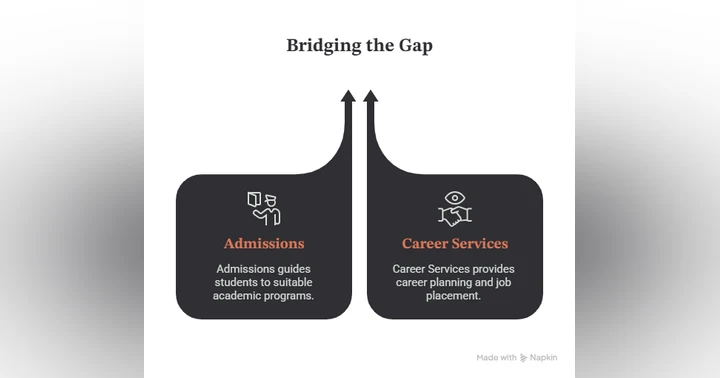
The Wall Between Admissions and Career Services Is Holding Students Back