What Your Data Cannot Tell You: Conscious Gratitude and the Interior Gap in Higher Education
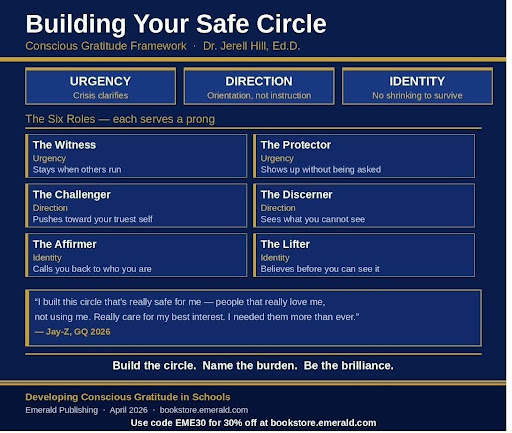
There is a meeting happening right now at a college near you.
Someone is pointing at a retention chart. Someone is asking why the numbers dropped. And somewhere in that room, a counselor who has held students through financial crises, housing instability, and grief is sitting quietly. She knows why the numbers dropped.
She just does not have language that will survive the meeting.
This is not a data problem. It is an interior problem. And higher education has not yet built the instrument to measure it.
We have become extraordinary at measuring what happens to students. Retention rates. Completion rates. Equity gaps disaggregated by race and income. The data is real. The commitment behind it is real. And something is still missing.
What the data cannot see is the interior condition of the people producing it.
Consider the frontline staff member who has navigated three student crises before noon, enforced a policy she does not believe in and smiled through a team meeting where her depletion was invisible. Her skill set is in your performance dashboard. Her formation is not.
That gap, between what the data measures and what it cannot reach, is where retention, equity, and institutional culture go quiet. I call it the interior gap. It is not new. It has just been unnamed.
What Conscious Gratitude Actually Is
Conscious Gratitude is not a wellness initiative. It is not a gratitude journal distributed at a staff retreat. It is a practice rooted in moral awareness and emotional intelligence, built on one foundational claim.
The interior life of an educator is not a personal matter. It is an organizational asset.
When that asset is depleted, every metric your institution cares about suffers at the point of human contact. Not because staff lack skill. Because the humans behind the skill have not been formed to carry the work for the long distance.
The Framework for Brilliance, an eight-practice approach developed across twenty-five years of classroom teaching, school leadership, and higher education administration, moves educators from deficit thinking toward asset-based formation. It asks educators to shift from seeing what students lack toward recognizing what students carry. From managing burdens toward cultivating brilliance.
That shift produces three interior movements in the educator doing the work.
Urgency without anxiety — knowing what matters and why, even when everything feels urgent.
Direction without rigidity — an interior compass that holds when the policy changes and the support disappears.
Identity without performance — the formation that allows a counselor to hold a struggling student without being consumed by the weight of what that student is carrying.
These are not soft skills. They are the architecture underneath every hard skill your institution is trying to build.
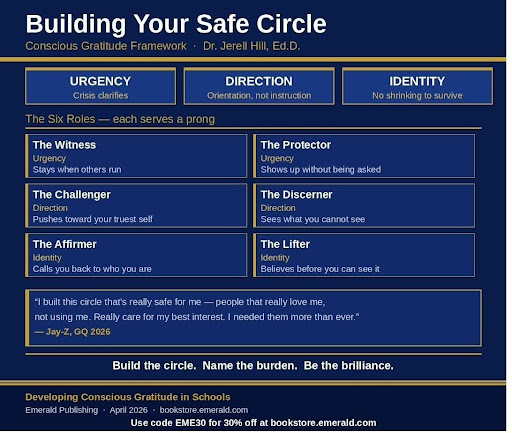
The six roles that make the interior work sustainable. From Developing Conscious Gratitude in Schools (Emerald Publishing, 2026)
The Gap Nobody Is Naming
Staff development is a direct investment in institutional performance. That is true and important.
The question the field has not yet answered is: what exactly are we developing?
Skill without formation erodes under sustained pressure. The institutions with the strongest equity commitment and the highest staff turnover are not failing because they lack training. They are failing because the humans carrying the mission have not been formed to carry it year after year.
Dr. Tyrone C. Howard, whose scholarship on educational equity has shaped the field for two decades, describes Conscious Gratitude as a practice that becomes “a moral compass, one that deepens our understanding of interconnectedness and strengthens our commitment to give back
with intention.”
That is the interior gap named from the outside by someone who has spent a career studying what inequitable systems cost the people inside them.
What This Looks Like in Practice
At Los Angeles City College, I serve more than ten thousand students annually. Many are first- generation. Many are navigating housing instability, work, and family obligations alongside a college schedule. The staff serving them are among the most committed I have encountered in twenty-five years of education.
They are also among the most depleted.
Not because the work broke them. Because no one built the interior architecture to sustain them through it. Conscious Gratitude addresses that directly. Not as a program layered onto existing professional development. As a formation practice embedded in how institutions understand and develop their people.
The counselor who holds a student across the transfer threshold does not do it because of a protocol. She does it because something inside her has been formed for that moment. That formation is not accidental. It is not personality. It is the result of intentional interior work.
Your institution can build for it. Or you can keep measuring what happens when it is missing.
The data shows the outcomes. This work goes to the source. Developing Conscious Gratitude in Schools: A Blueprint for Shifting from Burdens to Brilliance. (Emerald Publishing, April 2026) is the place this conversation continues.
About the Author: Dr. Jerell Hill, Ed.D., is Dean of Counseling and Guided Pathways at Los Angeles City College. He is a Heartademic- a scholar whose research emerges from reflecting on the interior life of the work, not only its outcomes. His book Developing Conscious Gratitude in Schools is available at bookstore.emerald.com. Use code EME30 for 30% off.
Consensus Is Sort of Like True Love