The Real Math Crisis Isn’t Skills - It’s Relevance

Math Relevance Crisis
There is a math crisis in higher education, but remediation versus rigor is not the most urgent debate. The deeper problem is that students are not connecting what they learn to their lives. Until we fix that, neither approach will work.
Anyone teaching math or the physical sciences sees it: students struggling with foundational skills. The issue has been widely noted, including in an Atlantic piece asking what happens when even college students cannot do math anymore. Faculty across disciplines are sounding the same alarm.
It is not hard to understand why. Many of today’s students spent formative years in disrupted learning environments. The result is not just a learning gap; it is a disconnect.
In my general education physics course, I often have to teach basic algebra and graphing before getting to the core material. Colleagues report the same. We debate solutions, more remediation or a stricter “sink or swim” approach, but that conversation misses something more fundamental.
Students are optimizing, not learning.
They calculate the minimum effort required to achieve a desired grade, compartmentalize the information, and discard it after the exam. General education courses, especially outside their majors, feel like obstacles. When students are balancing jobs, internships, and extracurriculars tied directly to employment, that mindset makes sense.
We know the value of a liberal arts education. Convincing students of that value is the challenge.
So I have stopped assuming they will make the connections on their own. I make them explicit, and I build them into the course.
When my students learn to graph data, we do not stop at physics problems. Early in the semester, I introduce stock market data. Students track gains and losses over time, interpret trends, and learn where to find this information. The lesson is simple: the same skills they use in class apply directly to their financial futures.
Later, when we model population growth, we extend the discussion to interest rates and investment returns. In one exercise, a hypothetical investor earns less than a 1% return. When I ask whether that is a good investment, many students initially say yes. That moment opens the door to conversations about inflation, APR, and long-term planning.
These are not detours from the curriculum. They are applications of it.
And they change how students engage. When abstract concepts map onto real decisions, how graphs relate to their money, how exponential growth affects their lives, math becomes something to use, not just something to pass.
Many faculty want to do this but hesitate. It can feel like stepping outside one’s discipline. I am a physics professor, not a financial adviser. But students do not need me to be a finance expert; they need me to model how to think across contexts.
When I bring in real-world examples, I am clear about limits. I tell students not to take investment advice from me and encourage them to keep learning. The goal is not to teach finance; it is to show how analytical tools transfer beyond the classroom.
If we want students to value what we teach, we have to demonstrate its relevance, not just in theory. That means being explicit about why skills matter and, sometimes, putting those applications on assessments so students take them seriously.
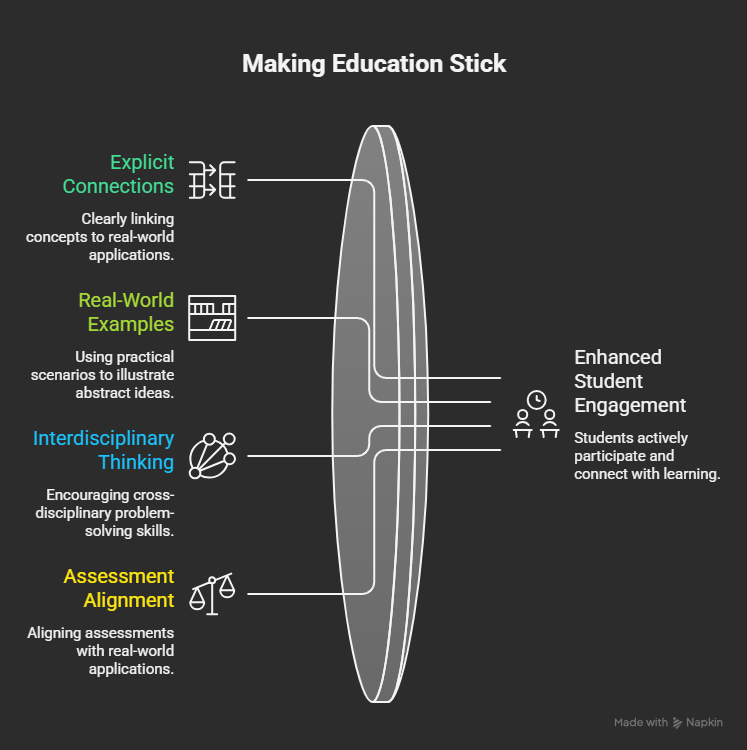
We are not going to solve the math crisis overnight. But we can change how students experience our courses.
So here is the call: push the boundaries of your syllabus. Make the connections for your students, even if it means stepping slightly outside your disciplinary comfort zone. You are already an expert in critical thinking. That is what matters most.
If students leave our classrooms with stronger habits of mind and a clearer sense of how to apply what they have learned, we have done more than cover content. We have made education stick.
And right now, that’s exactly what higher education needs.
**
M. J. Wright<https://www.adelphi.edu

The Wall Between Admissions and Career Services Is Holding Students Back