Aligning Revenue and Reputation to Drive Results
A Creative Degree Is An Economic Advantage, Not a Risk-
-Aligning Revenue & Reputation to Drive Results, by Dr. Shantay N. Bolton, President and Chief Executive Officer of Columbia College Chicago-
In an era defined by automation, artificial intelligence, and economic uncertainty, families and students are no longer asking whether a college degree matters. They are asking a more urgent question: Will this education prepare me for a good-paying career in a workforce that keeps changing?
As graduates cross stages this spring and their families weigh what comes next, creative and arts-focused institutions like Columbia College Chicago offer the answer: a resounding yes.
The myth of the “starving artist” belongs to the past. Today’s creative students are not choosing passion over practicality; they are choosing both. A creative education is not a luxury, a fallback, or a gamble. It is one of the most practical investments students can make in a labor market that increasingly rewards adaptability, innovation, and human-centered problem solving, where a premium will be placed on original thinking – the very skills creative institutions and colleges are uniquely positioned to prepare graduates with that employers actually seek.
The outdated narrative suggests that creative degrees lead to fewer opportunities or lower wages, which misunderstands both the modern workforce and what a contemporary creative education delivers: rigorous academics paired with applied learning, industry engagement, and real-world experience that translates directly into meaningful careers.
At Columbia College Chicago, the data makes one thing clear: creative education works.
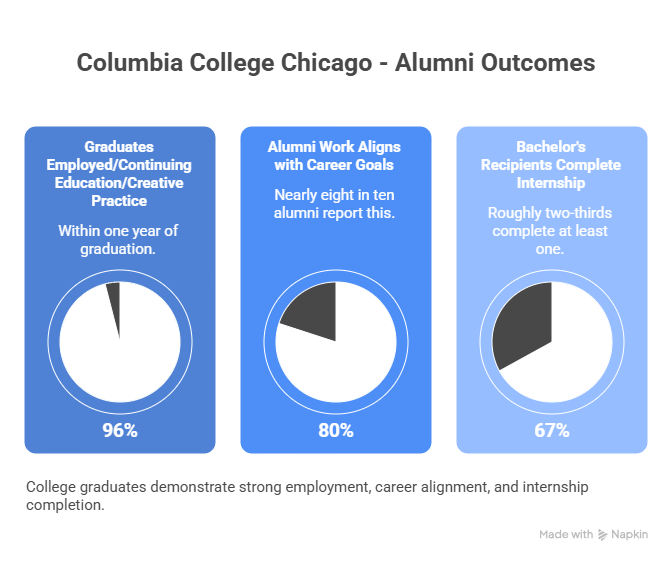
According to the college’s most recent alumni outcomes, 96 percent of graduates are employed, continuing their education, or actively engaged in creative practice within one year of graduation. Nearly eight in ten alumni report that their work aligns with their long-term career goals, and roughly two-thirds of bachelor’s degree recipients complete at least one internship, gaining hands-on experience and professional networks before they graduate.
Our alumni build careers across media, technology, marketing, health care, education, nonprofit leadership, and entrepreneurship. Many begin their careers with modest salaries, as do graduates in most fields, but their earnings grow over time. Longitudinal data show incomes increase as graduates advance, specialize, and step into leadership roles, reflecting the adaptability and career mobility that creative education provides.
Our graduates not only become artists, filmmakers, designers, or musicians, though many proudly do. They become entrepreneurs, brand strategists, legal professionals, product managers, UX designers, marketers, educators, business and nonprofit leaders, and founders. Their skills travel because creativity travels.
At Columbia College Chicago, students don’t simply earn degrees in creative fields; they learn how to translate creativity into opportunity at every stage. A fashion student doesn’t just learn how to design a dress; they learn how to take an idea from concept to market, understanding production, branding, digital storytelling, and how audiences and influencers shape demand.
Film students don’t just write scripts; they learn how to produce, direct, edit, and bring their work to theaters and streaming platforms.
These are not “soft skills.” They are competitive advantages.
Creative industries are powerful engines of economic growth, and in Chicago, the city itself becomes an extension of the classroom. Arts, media, design, and video production generate billions in economic activity while providing creative students with direct access to real-world experience, industry partnerships, professional networks, and career-launching opportunities.
To dismiss creative degrees is to misunderstand how value is created in today’s economy. It is also to overlook where innovation and workforce demand are headed.
Creative institutions have long expanded access for first-generation students, students of color, and students whose talents may not fit neatly into standardized measures of achievement. At Columbia College Chicago, we recognize that talent takes many forms and that economic mobility depends on widening, not narrowing, how we identify and cultivate it.
Critics often fixate on starting salaries alone. But careers, particularly creative ones, are rarely linear. As with most professions, earnings grow with experience, specialization, and adaptability. And in moments of disruption, those who can imagine new models, humanize technology, and tell compelling stories move fastest and lead society forward.
A creative education is not about choosing passion over practicality. It is about aligning purpose with economic reality.
As higher education faces increasing skepticism and families demand clear returns on investment, creative institutions like Columbia College Chicago offer a compelling answer: an education that prepares students not for a single job, but for a lifetime of adaptable, meaningful, resilient work.
That’s not a risk. It’s strategic professional fluidity.
**
Header Image Photo Credit: Columbia College Chicago (Julie Lucas Staff Photographer)
Shantay N. Bolton, Ph.D. is President and Chief Executive Officer of Columbia College Chicago. As the college’s 11th president, she leads the institution in its mission to provide a comprehensive education in media arts, technology, and business within a context of enlightened liberal education.
The Wall Between Admissions and Career Services Is Holding Students Back