Consensus Is Sort of Like True Love
Consensus Is Sort of Like True Love
Ali Houshmand took Rowan University from five colleges to fifteen, and from no medical school to three. Asked how, he did not describe a planning process: "We don't get everybody together and we all have to agree on something. Consensus is sort of like true love. It really doesn't exist. We might try to reach it, but we'll never get there."
Across 240 interviews with sitting presidents, the leaders who actually moved their institutions had that in common. They were not the best-liked people on their campuses. Several were actively hated for a stretch, and the presidents who avoided that, who compromised on essentials to keep the room calm, who waited for a consensus that never arrived, did not save their institutions.
Their institutions remained safe, popular, and increasingly irrelevant.
Everything launches. Nothing ends.
Higher education has spent twenty years adopting the vocabulary of business. Chief officers everywhere, strategic plans with KPI dashboards, enrollment funnels, brand architecture, and customer journeys all telling the story of the sector.
Higher education imported the organizational chart and skipped the only discipline that makes a business work: you kill what isn't working, on a schedule, before it kills you.
A company that launches a product line sets a number and a date. Miss the deadlines and the line is shut down; the people are redeployed, and the capital moves to something with a pulse. Nobody treats the shutdown as a moral failure, it's just a mechanism.
Higher education launches programs and then defends them indefinitely. Low-enrollment majors persist for a decade because elimination is politically expensive and no one wrote down, at launch, what failure would look like. The cost isn't the program. The cost is every dollar and every faculty line trapped inside it while the market moves.
The presidents gaining ground closed that loop. Fast launches came with explicit enrollment and employment targets and a defined window. Miss the window, the program ends. That isn't ruthlessness — it's what makes speed survivable, and it lowers resistance rather than raising it, because a reversible decision is a cheaper decision to let someone else make.
An institution that cannot end a program cannot responsibly start one.
Feedback versus resistance
The commanders who lasted learned to tell two things apart, and the distinction is worth more than any strategic plan.
Some criticism identifies a real implementation problem. Some criticism just opposes change. The first improves the decision and the second is the status quo defending itself in procedural language.
Adjust when critics have substance but proceed when critics center on ideology.
Most presidents can't do this, because telling the difference means risking being wrong about which one they're hearing, in public, in front of people with long memories. The ones who can stop spending years trying to convert the unconvertible. They find the people already moving, invest there, and build on a coalition instead of waiting for unanimity that was never coming.
John Jackson came to Jessup University in 2011 from the pastorate and the startup world and found out what that costs. "My first five years, I survived two assassination attempts," he told us. "Not real assassination attempts, but faculty and board going, 'hey, we think you're done.'" He stayed. The Bible college with no math, no science, and no graduate programs became a university that has since absorbed another institution that couldn't make it. His summary: "I'm not a bureaucrat, I'm a barbarian. You've got to have somebody willing to break some glass."
JuliAnn Mazachek took the quieter route to the same place. She named three priorities at Washburn and told the campus that if an idea didn't fit one of them, there was no need for the meeting, because the answer would be no. Every president reading that recognizes the eighteen months of committee time it saves.
The part that costs
None of this is free. The version told from conference stages usually stops before the bill arrives.
The line that matters isn't faculty versus president. It's substance versus speed and the clock belongs to the president. What gets taught is a question of expertise. When it launches is a question of survival, and markets move faster than any consensus can form.
Presidents who broke glass without first building a real shared understanding of what was threatening the institution didn't get transformation. The ones who succeeded spent months on that groundwork before they ever moved fast, and took public responsibility when the backlash came, rather than letting a board or a cabinet absorb blame that was theirs.
Several told us they planned to stay ten years or more, specifically because transformation outlasts the average presidential tenure. That's the real price. It isn't the conflict, it's the years.
The question
So ask the uncomfortable one at your next cabinet meeting: name a program this institution has ended in the last five years.
If the answer takes more than a few seconds, you don't have a strategy. You have an inventory.
What isn't in this article
Four presidents appear above. We interviewed 240, between April 2022 and December 2025. More than a few told us things on the record that they had not yet told their own boards.
The bluntest were the ones whose institutions didn't make it. They were specific about the warning signs they missed and about how much earlier those signs arrived than anyone wants to believe. One of them had a twelve-to-eighteen-month window and used every week of it. Another had six weeks and no options left.
What separated them is in the book. So is what the other 236 said.
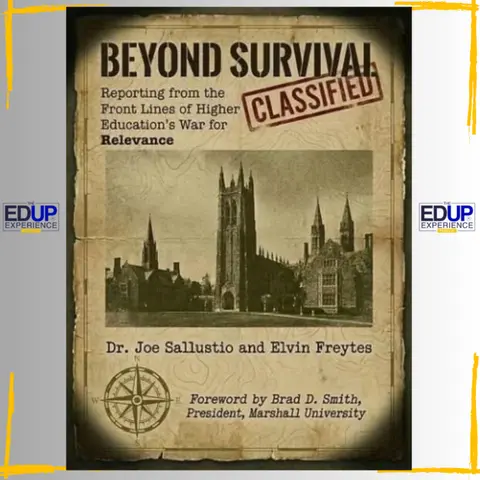
[Beyond Survival: Reporting From The Front Lines Of Higher Education's War For Relevance — available now on Amazon]
Dr. Joe Sallustio and Elvin Freytes are the co-founders of The EdUp Experience and the authors of Beyond Survival: Reporting From The Front Lines Of Higher Education's War For Relevance (EdUp Press, 2026), built on 240 on-the-record interviews with sitting college and university presidents conducted between April 2022 and December 2025.
Why Colleges Waste Space: Clarity, Direction, Incentives