AI Makes the First Draft Easy - Make Students Do the Hard Part
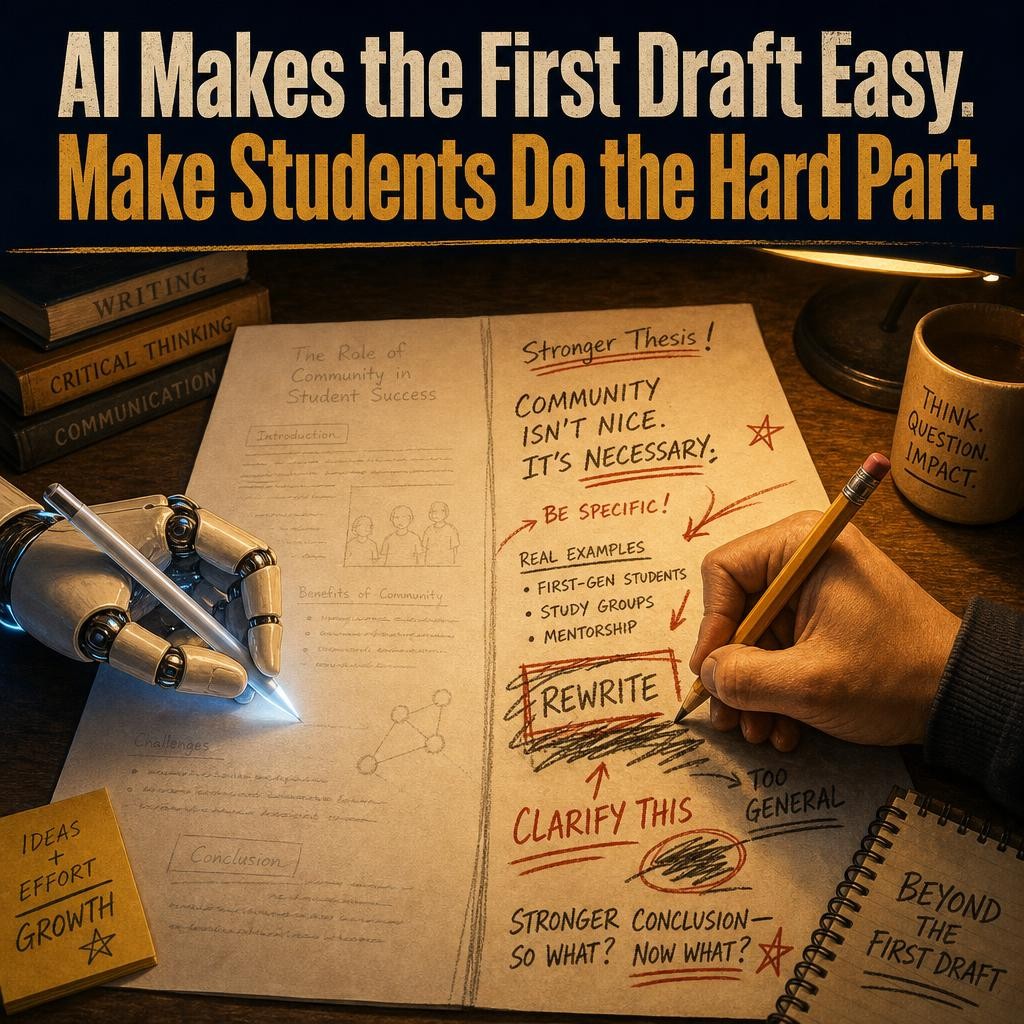
AI Makes the First Draft Easy. Make Students Do the Hard Part.
M. J. Wright
I recently built a computer game for my best friend’s 50th birthday. Earlier that day, I built a searchable career tool for physics students. In my lab, my students and I have also been designing printed circuit boards without relying on traditional CAD software. What surprised me was not simply how quickly AI helped me produce these things. It was how quickly I could get to something that looked finished.
That shift matters for higher education. AI can now produce a credible first draft of a paper, model, program or prototype in a matter of seconds. For faculty, the challenge is no longer just preventing students from handing the work over to AI. It is making sure that first output becomes a starting point for deeper thinking, testing and refinement rather than the finish line.
As someone who has spent years programming and designing, I initially wondered whether those skills were becoming obsolete. My experience has pushed me toward the opposite conclusion. AI can make building easier and faster, but speed does not tell us whether the result is accurate, useful or even good. The more important skills are knowing what to ask for, recognizing what is wrong, testing the result and refining it until it can withstand scrutiny. Those are the habits we should be teaching students.
Computer scientist Jennifer Chayes recently argued on Science Friday that students need both foundational knowledge and practice working in “AI hybrid teams.” That balance matters. AI may lower the technical barrier to creating something, but it does not eliminate the need to understand what you are creating or how to judge it.
Years ago, a C-level executive I worked with told me that the remarkable thing about software is that it begins as a blank screen and can become almost anything. The catch has always been the expertise required to make that happen. Coding, CAD and other specialized tools took years to learn. Generative AI is lowering some of those barriers. But lower barriers to production should not mean lower standards for what we accept as finished work.
The First Working Version Is Not the Finish Line
This is where my experience teaching scientific computing has become especially useful. For about 15 years, I have watched students reach the moment when their model finally runs and declare, “I’m done.” Usually, they are not. Getting something to work is only the first step.
As the instructor, I would follow up about:
-
How did they test the model and validate its results?
-
What happened when they pushed the model beyond the obvious cases?
-
Where and why did the model break down?
-
How could they extend it to account for new physics, variables or constraints?
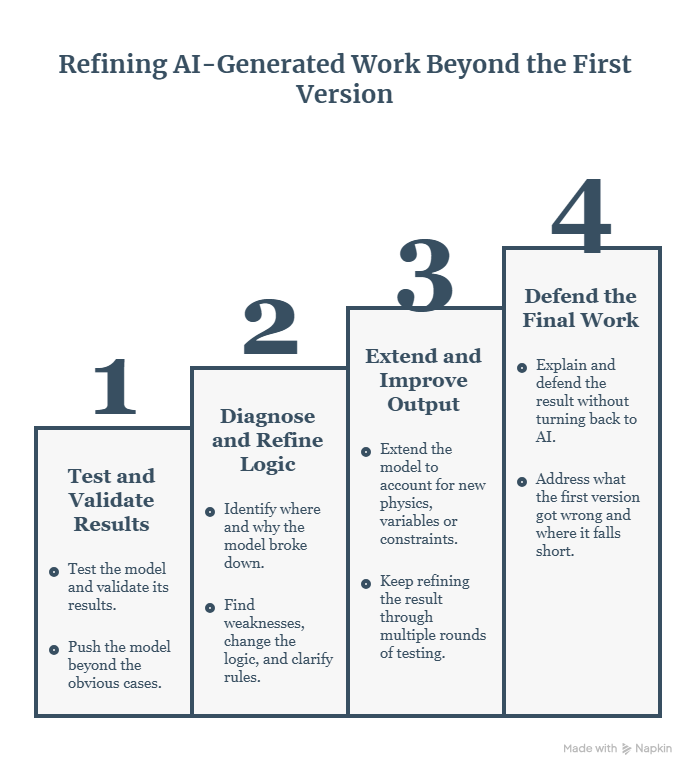
AI makes that “I’m done” moment arrive much earlier. When I asked AI to generate the birthday game, I had a working version in moments. But that was not the finish line. It was the starting point. I tested the game, found weaknesses, changed the logic, clarified the rules and kept refining the result. The document I used to direct the project eventually grew to more than 10 pages because each round of testing exposed something else that needed attention.
That experience changed how I think about what I call the 80/20 problem. AI can often get a student to something that looks 80 percent finished remarkably quickly. The educational danger is mistaking apparent completion for mastery. If the first 80 percent becomes easier to produce, faculty should put more of the rigor into the final 20 percent: validation, stress-testing, diagnosis, revision and defense of the work.
For faculty, that means asking students to go beyond what AI gives them. What did the first version get wrong? How did they test it? Where does the final product still fall short? What did they change, and why? Can they explain and defend the result without turning back to AI for the answer?
Those are the habits that matter.
In my lab, I use a simple mantra: “You lead AI. AI doesn’t lead you.” Students can use AI to move faster, but they still have to know where they are going, recognize when something is wrong and take responsibility for the final result.
If AI makes the first version easier, our standards for what comes next should get higher, not lower.
M. J. Wright is a professor of physics at Adelphi University on Long Island with a focus on quantitative reasoning and science education.
Consensus Is Sort of Like True Love