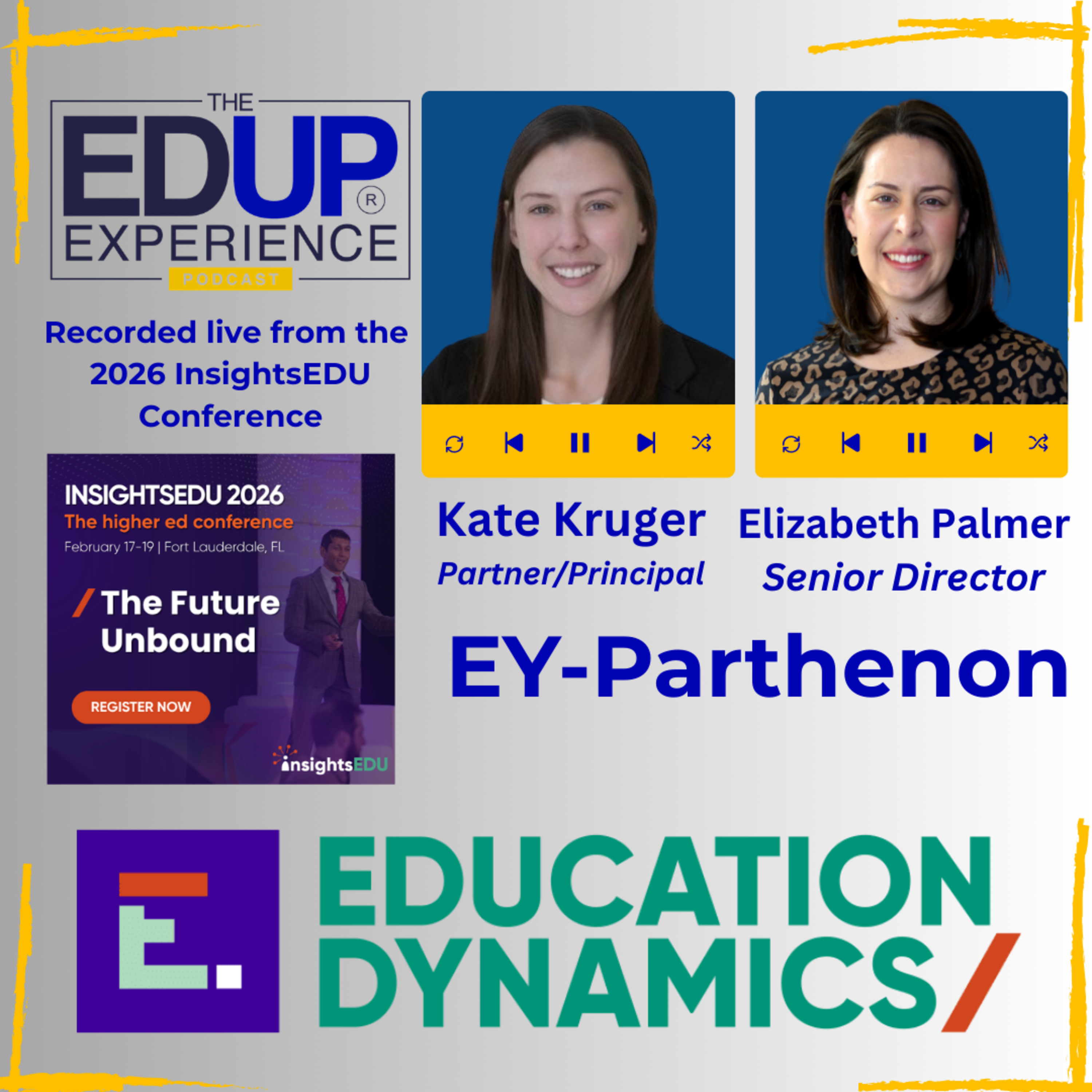
LIVE from the 2026 InsightsEDU Conference - with Kate Kruger, Partner/Principal, Elizabeth Palmer, Senior Director, EY-Parthenon


 Apple Podcasts Apple Podcasts
  Spotify Spotify
  iHeartRadio iHeartRadio
  Youtube Music Youtube Music
  Audible Audible
  Amazon Music Amazon Music
  Pandora Pandora
  YouTube YouTube
  Overcast Overcast
  Castro Castro
  PocketCasts PocketCasts
  Castbox Castbox
  Podchaser Podchaser
  TuneIn TuneIn
  Deezer Deezer
  RadioPublic RadioPublic
  Podcast Addict Podcast Addict
  Anghami Anghami
  PlayerFM PlayerFM
  Goodpods Goodpods
  Audacy Audacy
  Castamatic Castamatic
  JioSaavn JioSaavn
  RSS Feed RSS Feed
 It's YOUR time to #EdUp with Kate Kruger, Partner/Principal, Elizabeth Palmer, Senior Director, EY-Parthenon
In this episode, recorded Live from the 2026 InsightsEDU Conference in Fort Lauderdale, Florida, February 17-19,
YOUR host is Dr. Joe Sallustio
- How does EY Parthenon's 25 year practice verify career is top priority when college grad unemployment reaches 5 to 6% nearing non degree holders?
- Why do students choose majors based on AI exposure when business & marketing are highly exposed while healthcare & education are less exposed?
- What makes alignment require clarity around narrow priorities backed by financials when too many priorities without resources prevent execution?
Listen in to #EdUp
Thank YOU so much for tuning in. Join us on the next episode for YOUR time to EdUp!
Connect with YOUR EdUp Team - Elvin Freytes & Dr. Joe Sallustio
● Join YOUR EdUp community at The EdUp Experience
We make education YOUR business!
P.S. Want access to the only intelligence platform built exclusively from presidential conversations in higher education? Join EdUp Leadership!
America's Leading Higher Education Podcast
America's Leading Higher Education Podcast Network
Elvin Freitas (0:00): Welcome back, everybody. It's your time to add up on the EdUp Experience podcast where we make education your business here on location at InsightsEDU in Fort Lauderdale, Florida as we talk, to colleagues across higher education companies about the modern learner, what it takes to recruit and hold this, evolving student. You can insights that they well, literally insights you can only get here at Insights e d u. How do you like that? Cofounder of the experience, Elvin Freitas.
Unknown Speaker (0:29): And that's why you've been podcasting for over a 300 episodes. Well done. Victory. I'll take I'll take what I can get. If I get a compliment from Elvin, it's a it's a it's a great day.
Elvin Freitas (0:39): It happens about once a year. We have two people with us. I'm I'm gonna, admit something. It's possible. It's possible.
Elvin Freitas (0:49): It can't be verified, but I had these two people on with me last year at this very same conference. It's possible that I didn't turn on one of the microphones. We went back and we listened to the episode, and one of these individuals was like, what do you think other individual? And then he was like, dead silence. And I was like, it's totally their fault.
Elvin Freitas (1:15): They must have done something in my microphones. I'm pretty sure it was Elvin's fault. Yeah. Looking back, I'm pretty sure Elvin hit a button on accident. He was messing around with my stuff, but we wanted to have them back so we can knock it out of the park this time.
Elvin Freitas (1:30): I've had to take a look. My recording button is on. All of these stations are on, and I'm gonna bring them in one at a time now. Excuse me. I don't think there's any way we can mess this up.
Unknown Speaker (1:39): Although, I don't wanna over promise. There's a way. Ladies and gentlemen, Keith Krueger and Elizabeth Palmer, a partner and principal and senior director respectively at Parthenon. Ladies, welcome back. Thank you.
Unknown Speaker (1:51): How are doing?
Unknown Speaker (1:52): Good to be here.
Elvin Freitas (1:53): So, yeah, you guys agree. Alvin's fault, right?
Unknown Speaker (1:55): For sure.
Elvin Freitas (1:56): Oh. Thank you, Post. It's messed up. Well, Parthenon, and we'll go to you, Kate, first. Give us why we should know Parthenon.
Elvin Freitas (2:06): What do you guys do, and why should we know?
Kate (2:08): Yeah. Great. Parthenon is the strategy arm of the broader Ernst and Young firm, and Parthenon has had a dedicated education practice for twenty five years. We work with higher ed institutions, k 12 school districts, the investor community, vendors in the space, And so we really have a three sixty view around the sector and think that we can share some helpful trends with the audience here.
Elvin Freitas (2:35): Well, I would like to know about those trends. Elizabeth, to you first. Before we get to those trends, you guys are here at InsightEDU. You've come multiple years. What have you been what let me try that again.
Elvin Freitas (2:48): I said we couldn't mess it up, and there I go. What have you learned so far, and what do you hope that you could take away from this conference?
Unknown Speaker (2:54): One of the things that we learned last year is that there is a high high degree of overlap between the research and the work that we do with our clients and the research that comes out of education dynamics and the modern learner report. So last year, it was a bit of a coincidence, and our findings overlapped very closely with the three Cs, cost, career, convenience, which we are not clever marketers, so we did not come up with that terminology, but our strategies were similar. And and this year, actually, we were have been noticing and observing with our clients that career has been the most important thing over the last twelve months or so, and that's exactly what the 2026 modern learner report found.
Elvin Freitas (3:42): Bullseye. So we call that verify. So you guys are verifying each other's information, which makes it more true and more, not in a more true, but it makes it more factual when you can have multiple sources sort of triangulate and you know, see that what are the trends driving that? We know some like, you know, relevance is in question. We know that the the students are really looking to say, what am I getting out of this now?
Elvin Freitas (4:06): But you mentioned trends. And so let's dive into some of those trends that might be helpful for our colleagues across higher ed.
Kate (4:13): Yeah, it's a great question. I mean, some of what we're seeing that is making students so nervous and so focused on career preparedness is that for the first time, we're starting to see actually deviation between young graduates of college and young workers generally, where the unemployment rate is starting to tick up for college graduates in a way that, you know, is only sort of five to 5.5%, 6% unemployment, but is higher than we've seen historically and is starting to come closer to individuals who don't have a degree. And so they're very focused on, if I'm gonna go to this school and spend all this money and time, I need to know that I'm gonna come out with the skills and experiences that are gonna set me up for career success.
Elvin Freitas (5:01): Anything to add to that? Anything you wanna pay piggyback on?
Elizabeth (5:06): Jess, they're also taking a look at the impacts that are potentially going to play out across different career paths. I think it's still fairly uncertain in different disciplines and different career fields how much AI exposure there will be and whether that means less hiring or if that simply means changes in terms of how AI and technology tools will be used in the job role. But they are starting to make their own observations, and and there's reports and data that is starting to come out that says things like business and management and marketing is a highly exposed field. Communications and social sciences are highly exposed fields. Health care and education, somewhat less exposed fields.
Unknown Speaker (5:51): They're sort of on the other end of the spectrum. And so we're starting to see that play out also in major decisions.
Elvin Freitas (5:57): The the pendulum pendulum pendulum or pendulum? Pen how many guys Got me on that one. Strategy consultant should know that pendulum pendulum. A while back, was like no liberal arts, right? I mean, everybody's cutting liberal arts.
Elvin Freitas (6:12): Now, we hear students are going to sort of hedge their bet because they don't want to go too deep into tech because it's going to change around them. So, get get the critical thinking behind you and then adopt the tech later. That makes a lot of sense to me. And all of a sudden, it's like, okay. Wait a minute.
Elvin Freitas (6:23): We're not gonna cut those programs. We thought we're gonna cut. But you guys get to walk in into an institution or work with an institution and say, here's what you need to do. And I think many of us know that the institution says, we don't wanna do any of that. We, well, no, I don't wanna have to change these things.
Elvin Freitas (6:42): How true is the, the narrative around higher ed is adverse to change? How true is that?
Elizabeth (6:53): It's a mixed answer. So it's not as though higher ed is averse to change in the sense that people don't see that there is change all around and that there's a need to adapt. But there are sort of long standing traditions and ways of working that have been really important to higher ed success historically, and deviating from those is challenging, but sometimes necessary to make whole scale transformations.
Elvin Freitas (7:22): So That's a really nice way to say the way they have working before is not working now, so change your way of working. But you said it so much better than I did.
Kate (7:30): I I think, though, what some of our research showed is that we would say they need to sharpen their value proposition as opposed to upend it. Like Mhmm. There are things that are working. We're seeing college going rates from high school graduates as strong as they've been since 2019. So, like, there is something there, right?
Kate (7:48): Like, students still are recognizing the value proposition. They want to go to school, but they have these priorities cost, career, convenience and institutions need to hone in on those areas rather than, you know, completely throw out every the baby with the bathwater.
Elvin Freitas (8:04): Are are they focusing on those areas as sharp as sharpening the pencil, as you say? It is it the realization that's missing? Like, we gotta get sharper. We gotta get better into our business. We need to, you know, rather than maybe expand, we need to get better at what we do or or maybe decide what it is, what we, what, what it is that we do because sometimes there's an imbalance or ground or online.
Elvin Freitas (8:27): We're hybrid. We're flexible. We're this. We're that. We're everything to everyone And then resources sort of dissipate across those models and nothing is strong.
Elvin Freitas (8:36): Where is the pencil need to be sharpened?
Kate (8:39): Yeah. I mean, I think it's a spectrum. And, you know, again, everything for us sort of comes back to this cost career or cost convenience career. Cost and convenience are starting to be more table stakes. Everyone sort of has online programs mixed Everyone's delivery sort of working on affordability.
Kate (8:57): The past ten years have seen very little actual increase in tuition prices relative to the thirty years before. And so career is really the next frontier. And I think it, again, is a spectrum. There are some institutions, liberal arts institutions, big publics, who you would not expect this to be coming from, but are saying our top five priorities, one of them is career preparedness, and, like, we are going to invest there and pull resources from other things. And it's really about execution and how hard it is to execute.
Kate (9:28): And then I think others Elizabeth, you can probably speak to this in more detail, but it's more about realization. Right? They're sort of not yet at the point where they're committed to introducing the the career preparedness priority as robustly?
Elizabeth (9:43): Well, and not bringing it into the student experience in an integrated way. That's a critical finding in our work is it's not enough any longer to say career preparation is something you can opt into. It's something we offer. You know, Come to our office if you're interested. It needs to be embedded, and there's a whole host of different ways to do that.
Elizabeth (10:05): One way is to have career courses and a career course sequence that teaches students what you need when you're thinking about searching and preparing at every different stage along your journey. Another way is having experiential learning and making it actually a requirement. Having it be a requirement for an institution that doesn't have it today, going from not having it to having it, is challenging. It needs to be typically built into the core curriculum because it has to be a graduation requirement. Yep.
Elizabeth (10:34): So that requires going through faculty governance. So back to your point about is higher ed averse to change? No. But processes like faculty governance were built so that they're very thoughtful and methodical and they take time. And time to adapt is something that is increasingly scarce.
Elizabeth (10:51): We need to be able to adapt faster than historically.
Elvin Freitas (10:54): But we know that. Like, everybody I talked to, there isn't somebody that I talked to that goes, you know, I just don't think we need to move as fast anymore. We I know like, I know that everybody knows that yet still don't do it. That's the is the phenomena of of higher ed is we know that everything's changing around us. We know that sometimes shared governance and over socialization is slowing us down.
Elvin Freitas (11:17): Yet we're gonna do it anyway because that's what we've always done. And AI is moving so fast. Technology is moving so fast, and it's going to leave some people behind, don't you think?
Unknown Speaker (11:27): Absolutely. That there's going to be a range of outcomes, and not all institutions are going to have the same level of success because it's going to depend on how quickly it can adapt and bring stakeholders along. We saw examples this morning. Doctor. Doctor.
Unknown Speaker (11:40): Corey is a good example of being able to really transform an institution quickly. I'm sure I don't know him well, but I'm sure it has to do with having some visionary leadership and getting people on board.
Elvin Freitas (11:52): Yeah. You know, it's a visionary leadership is important. It's easy to say another thing you do, right? Like the we sometimes we say what we know we need to do. And then the doing part is is the hard, right?
Elvin Freitas (12:03): Like, I know I need to do this, but actually getting there. We I see presidents and we talk to presidents. Sometimes they move out of situations, when they can't get that momentum instead of sitting there and fighting it. They're like, you know what? Three, four years in, I'm just gonna go somewhere else that's more ready.
Elvin Freitas (12:19): And then that school sort of starts all over again and which is why you can have laggards and those that are moving quicker and those that aren't. What's the secret? How, you know, you guys are doing this strategy consulting. What, what do you say to schools that makes them go, you know what? Thank you for those insights.
Elvin Freitas (12:37): We're gonna we're gonna run with that right now. Like, what's the secret sauce?
Elizabeth (12:41): Yeah. I would say the places that we work that have the greatest success with making change happen quickly have alignment across their boards, their leadership, and their faculty.
Unknown Speaker (12:56): Mhmm.
Elizabeth (12:56): And and we've actually done projects where the committee, the steering committee is composed of those three groups. And and as long as you've sort of hand selected and have the right advocates and the right people around the table, that that can be very effective. And then using data to help create the case for change. That's very important as well.
Elvin Freitas (13:19): Anything you wanna add? No. One one keyword that I that I pull out of that, and I do talk about a lot is alignment. Right? This the leadership alignment, the the places that I've been where change succeeded.
Elvin Freitas (13:33): Everybody knows what the common goal is. Everybody's in and when that door opens, even when there's disagreement among the group on how to get there, everybody is going we're still going there. But when somebody shows that, that sort of like crack in the armor, that's when things start falling apart when you know. And and I know people like this that are like, you know what, Elvin? I don't know if he believes this.
Elvin Freitas (13:58): We're going to talk to him on the side. We're going get him back and say that he doesn't admit it. See if he can admit it. Melvin goes, yeah, you know, I said yes, but you know that, and that's when everything starts to fall apart. I mean, I know that's a foundation of the strategy consulting that you do is to fish out what alignment looks like.
Elvin Freitas (14:14): And how do you know that for sure? Is there a formula that you use when you're in there in schools that say, guys have the right alignment? Is it individuals? Is it a culture? What do you think?
Elvin Freitas (14:27): I know that's sort of a tough question, but
Unknown Speaker (14:30): Well, one thing I'll say is, and it comes back to something you said actually, is everyone knows the goal. Alignment requires having clarity around a narrow set of priorities. One of the challenges is having too many. And and often, you know, we'll start working with an institution and we'll pick up their latest strategic plan. And the strategic plan will have a priority for everyone and everything.
Unknown Speaker (14:56): And often not clarity about how it will be resourced because that's where the rubber beats the road.
Unknown Speaker (15:01): If you
Unknown Speaker (15:02): don't have the ability to resource the priorities, then you can't make them come to fruition. So maybe alignment for us, and we do work for an accounting firm, so, you know, is that there's clarity around the priorities, and then there's the financials that back it up.
Unknown Speaker (15:18): One thing go ahead. No. No.
Kate (15:19): Please. No. I was just gonna say, for me, it's not always clear exactly when you have it, but it is quite clear when you don't.
Unknown Speaker (15:25): Oh, So true. No doubt. So
Kate (15:27): true. And I think one of the things we often see is that a leader, an outgoing leader, may consider hiring us and say, I wanna leave my successor, you know, with a plan, and I wanna leave them in a good place. And it's like, that is never gonna work. Mhmm. Right?
Kate (15:42): It has to be whoever is going to own the execution and carry it through once we are gone has to drive the work and has to drive those priorities and work together with us. And I think if if you have those sort of right people with the right alignment and they are committed to the future and driving it forward, that's where we tend to see the most success.
Elvin Freitas (16:04): One thing you said, Kate, you you talked about the workforce sort of being ready for, you know, grads in in the workforce. Community colleges were sort of always doing that. And all of a sudden, four years, we've never had to do any of that before and go, okay. Wait. We need to manifest career outcome you know, career services and embedded in curriculum and track it over time.
Elvin Freitas (16:25): I don't know that everybody's ready for that level of transparency. I mean, they they probably done something, but they don't have the infrastructure for it, which is a missing piece. Am I right on that wrong for some?
Kate (16:36): I think that's right. And I think, you know, I spend a lot of my time on the investment side, working with private equity firms, working with vendors, and that's actually where we're seeing a lot of investment activity and growth right now is actually with vendors who can help partner with institutions to help them do just that, either on the career services side or helping them embed experiential learning capabilities and programs into their academic offering. They do need help, the four year institutions. This isn't natural to them. Sometimes there are folks that can help them.
Elvin Freitas (17:10): Anything else you want to say about Parthenon, either of you, and the work that you do, and maybe how we get in touch with you if we're interested in some consulting services?
Unknown Speaker (17:20): Sure. Well, just to say thank you to Education Dynamics for having us. It's been great to be back this year and to see even more convergence in our research and these are important topics of change and a lot of you know, new dynamics that need to be dealt with. So we're excited to see all of the AI tools that the Education Dynamics team has been rolling out. It's been learning for us as well.
Unknown Speaker (17:44): So thanks for having us, and best way to reach out to us would be go to our website. We're on LinkedIn.
Unknown Speaker (17:52): Find them. Yeah. Kate and Elizabeth. It's gonna be in the show notes. They're LinkedIn.
Unknown Speaker (17:55): Oh, yeah. Well, always puts stuff in the notes. Absolutely. We talked about that. Kate, anything else you wanna say about EY Parthenon?
Kate (18:02): No, mean, think as I mentioned at the beginning, I do believe the unique mix of work that we get to do across the education ecosystem, not only here in The US, but also globally. We have teams in Europe, in Asia, in Australia, you know, that work sort of across the globe and we team very well with really makes it, you know, a very fulsome group and perspectives that we have. And so we'd love the chance to, you know, chat with any of you who are interested.
Unknown Speaker (18:30): Well, I have to tell you, I'm proud of this episode that we got it right. I'm proud that Elvin didn't make another mistake. You turn off the microphone. Bam. Bam.
Elvin Freitas (18:37): Bam. I'm not sure that's a joke. Ladies and gentlemen, Kate Krueger, Elizabeth Palmer, partner, principal and senior director at Parthenon, and you've just ed up.


