Retention Is the Growth Strategy Higher Education Is Still Undervaluing
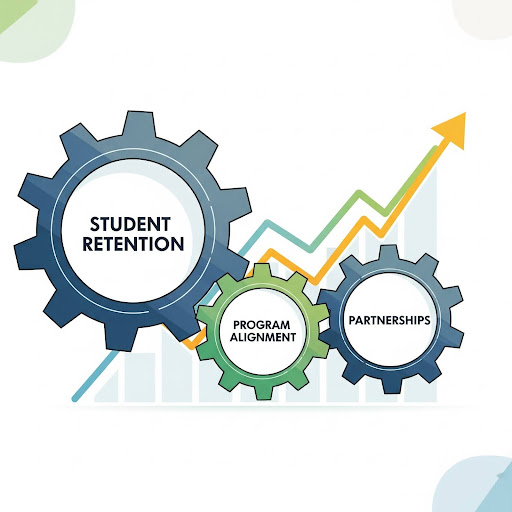
Retention Is the Growth Strategy Higher Education Is Still Undervaluing
Higher education leaders have spent the last decade doing important work to align programs to workforce demand, build online capacity, and strengthen employer relationships. But many institutions still underestimate the most fundamental shift of all: what today’s students actually want, and what it truly takes to recruit and retain them.
I’ve spent more than two decades at Utica University in roles spanning academic leadership, online program development, and institutional innovation. Today, as dean of the School of Health Professions and Education, my focus is clear: you can build a strong academic program, but without a clear enrollment and retention strategy, it won’t scale or sustain itself.
We optimized for industry and lost sight of the student decision journey
Over the years, higher education has become increasingly sophisticated in analyzing labor-market data, consulting with employers, and launching programs aligned with workforce gaps. That work is necessary. But too often, it happens without equal attention to how students discover programs, decide to enroll, persist through obstacles, and envision long-term value.
Students today, especially adult learners, are not looking for “13th grade.” They want momentum, relevance, and flexibility. They want to know that once they start, they can continue without having to transfer institutions, lose credits, or reset their identity every few years. Pathways are no longer a nice-to-have; they are an enrollment strategy.
Marketing is not a tactic—it’s an economic reality
One of the most misunderstood aspects of enrollment is cost. Modern student acquisition is expensive, and many institutions underestimate the resources required to recruit effectively across diverse audiences. High school students, transfer students, and adult learners respond to different messages, timelines, and value propositions.
If institutional leaders don’t understand cost-to-enroll by program, they make decisions that are misaligned with reality. When recruitment budgets fall short, retention becomes the only sustainable growth lever. Recruiting a student twice because you failed to retain them once is simply not a viable model.
Retention is the growth strategy hiding in plain sight
Retention isn’t just a student success metric—it’s a financial and reputational engine.
If you have to recruit a student twice because you couldn’t keep them once, your acquisition costs compound. For campus programs, that can mean replacing lost tuition and (often) lost room-and-board. For graduate programs, it’s even more direct: tuition revenue is the model. The most sustainable institutions don’t treat retention as an intervention; they treat it as a design principle.
At Utica, we’ve seen enrollment growth follow when three elements align by design: clearly articulated outcomes, student support systems calibrated to modality and life stage, and credibility that travels through professional networks. When those pieces are in place, retention becomes self-reinforcing.
Our online Family Nurse Practitioner (MS FNP) programs demonstrate this effect. Across the MS FNP and post-master’s certificate pathways, enrollment has grown to more than 450 students, supported by a 94% placement rate and consistent year-over-year growth. That scale was not driven solely by marketing. It was earned through faculty active in clinical practice, a dedicated team securing high-quality practicum placements, and an academic experience that mirrors the realities of the profession.
The same model applies in our Master of Social Work programs, which have grown to more than 200 enrolled students through intentional tracks, strong field partnerships, and learner-centered progression. Adjunct faculty and field supervisors—many of whom are employers themselves—become ambassadors as outcomes circulate through the regional workforce. In licensure-aligned programs, word of mouth consistently outperforms broad national advertising.
Cost, modality, and time to completion still matter. But in a crowded marketplace, they are insufficient on their own. Sustainable growth comes from selecting the right faculty, investing in community partnerships that anchor experiential learning, and maintaining clear completion standards. When the student experience delivers, retention follows—and students become the most credible growth strategy an institution has. It’s a reminder that when graduates talk, prospective students listen.
From articulation agreements to real partnerships
Most institutions have dozens of articulation agreements. Few have true pipelines.
Real partnerships require sitting at the table and asking, "What do you need? “What do we need? And can we build this together?” In regions with limited population growth and affordability challenges, dual-admission models with community colleges are not optional—they are essential.
In healthcare, this also means embedding students into the workforce early. Paid entry-level roles, clinical exposure, and employer-supported progression create persistence and purpose. Students should graduate not just with a credential, but with experience and a network.
Rethinking OPMs: transparency, flexibility, and fit
As many institutions have discovered, traditional bundled OPM relationships are not always a long-term solution. The issue is rarely outsourcing itself—it’s lack of visibility and limited ability to adjust when conditions change.
When we reevaluated our approach, what mattered most was finding a partner willing to work in an unbundled, transparent way, so we could understand the inputs behind enrollment and retention rather than operate in a black box. That’s where Collegis Education fits our needs.
As we transitioned programs and assessed performance cycle by cycle, Collegis’ team worked alongside us to examine who was enrolling, who wasn’t, and why. When recruitment economics no longer aligned with institutional budget realities, the partnership allowed us to pivot—redirecting effort toward retention, operational stability, and core systems support rather than forcing continued investment in underperforming programs.
That flexibility mattered. It preserved trust, supported institutional decision-making, and allowed us to reallocate resources responsibly. In an environment where institutions are questioning whether to outsource, insource, or hybridize services, partnerships that allow recalibration—not escalation—are what sustain collaboration.
Looking outside—and leading with clarity
The most important lesson I’ve learned is that institutions cannot rely on themselves for all their answers. Leaders must seek external perspectives from peers, partners, employers, community colleges, and, most importantly, students, ask uncomfortable questions, and be willing to change course.
The institutions that will thrive are those that understand the full enrollment funnel, invest realistically, build fewer but stronger partnerships, and communicate progress consistently. Higher education still matters deeply, but relevance today is earned through execution, alignment, and trust.
By Polly J. Smith, Ph.D., is the dean of the School of Health Profession and Education at Utica University with expertise in program growth and development, online learning, partnerships, and academic operations.
Navigating Automation’s Inevitability with a Human First Competitive Edge


