2025 Higher Education Trends - from ~100 College/University Presidents

2025 Higher Education Trends
The 10 Topics That Defined Higher Education in 2025 Discussed On The EdUp Experience Podcast
Are you preparing students for AI or policing them?
That's the question ~100 college/university presidents grappled with in 2025. And we have something no one else in higher education has: the comprehensive dataset to answer it.
Over 365 days, we conducted ~100 presidential interviews spanning every institution type including community colleges to R1 research universities, HBCUs to state systems, and regional comprehensives to for-profits. We analyzed over 23,000 lines of transcripts to identify the patterns separating institutions moving fastest from those standing still.
This knowledge base, this scale of presidential insight, exists nowhere else in higher education. No consulting firm has this access. No survey has this depth. No conference has captured this level of candid conversation.
What emerged isn't what you'd expect from reading trade publications or attending conferences. The real conversations happening in presidential offices tell a fundamentally different story about where higher ed is heading.
The AI Paradox Takes Center Stage
Artificial intelligence dominated 2025 conversations, appearing in over 40 episodes with 3,878 total mentions. The conversation wasn't about technology, it was about relevance.
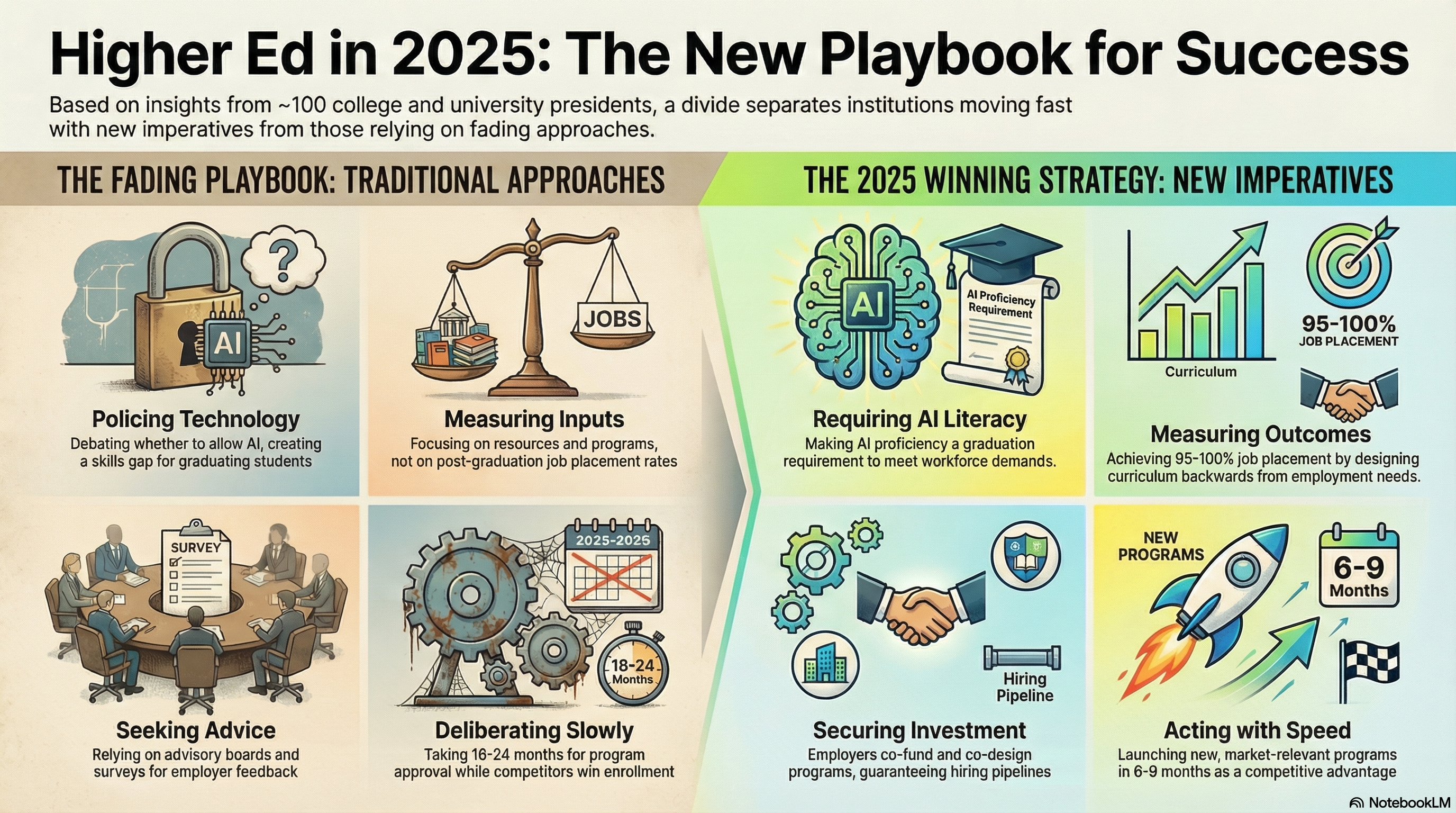
The workplace requires AI literacy from day one. Students are entering jobs where AI tools are as fundamental as email. Yet institutions are caught in a paradox: prepare students for this reality, or restrict technology use and create a dangerous skills gap.
The institutions moving fastest aren't debating whether to allow AI in classrooms. They're making AI literacy a graduation requirement, addressing and engaging resistant faculty through strategic change management. HBCUs are leading this charge, positioning themselves at the forefront of AI bias research where their lived experience creates unique research advantages.
Outcomes Became Non-Negotiable
Job placement rates moved from aspirational metrics to accountability requirements. The shift is stark: outcome-based funding is transforming higher ed from measuring inputs (resources, facilities, programs) to measuring results (employment, salaries, career advancement).
Here's what surprised us most: 95-100% placement rates are achievable, not theoretical. The institutions hitting these numbers share common characteristics including employer-designed curriculum, work-integrated learning models, and co-op programs giving students 2+ years of professional experience before graduation.
The strategic insight? Job placement isn't the responsibility of career services anymore, it's the imperative of curriculum design. When programs are built backwards from employment outcomes, the results follow.
System Thinking Separates Scale Leaders
Managing hundreds of thousands of students across dozens of campuses requires fundamentally different thinking than single-campus leadership. We heard this repeatedly from system chancellors overseeing 90,000 to 500,000 students.
The mastery isn't in managing more campuses, it's in knowing what to centralize for efficiency (technology infrastructure, purchasing power, data systems) and what to decentralize for innovation (academic programs, campus culture, pedagogy). System leaders think in patterns invisible to individual institutions. When you can see dropout trends across 14 or 64 campuses simultaneously, you solve structural problems others can't even identify.
The Partnership Evolution
Perhaps the most significant shift is employer relationships evolving from advice-seeking to investment partnerships. The old model, survey employers annually, form advisory boards, asking "what do you need” is giving way to something more substantial.
Some employers are now funding credential programs at $10,000 per student in some institutions, co-designing curriculum, providing equipment and labs, and guaranteeing hiring pipelines. The insight that emerged? Financial commitment reveals the market demand better than surveys ever could. When employers invest real money, that's validation. When they just advise, that's conversation.
Speed as Existential Advantage
Traditional program approval processes taking 18-24 months are creating competitive death spirals. Institutions launching programs in 6-9 months are winning enrollment battles in real-time while others are still in committee reviews.
One president captured it perfectly: "Whoever has the idea, it's a great idea. Let's move forward." This philosophy of simplicity over complexity, action over endless deliberation, separated thriving institutions from those protecting bureaucratic processes into irrelevance.
The uncomfortable truth presidents shared was that complexity is comfortable for academics. Simplicity requires courage.
The Conversations We're Finally Having
What struck us most wasn't the strategic insights, it was the authentic vulnerability. Presidents in 2025 began openly discussing challenges like security threats requiring protective vests, 13-year tenures in an era where four years is average, financial pressures forcing impossible decisions, and faculty resistance to necessary change.
This transparency isn't a weakness, it's strategic leadership for uncertain times. Presidential credibility in 2025 came from honesty about constraints combined with clear action plans, not from projecting invulnerability.
The Complete Picture
The remaining topics including regional economic impact (universities as job creators, not just educators), data-driven retention (predictive analytics preventing failure before it happens), basic needs security (food and housing as retention infrastructure), and enrollment innovation (removing barriers rather than raising them), paint a comprehensive picture of transformation.
What separates 2025 from previous years isn't any single innovation. It's the convergence of multiple pressures forcing institutions to choose sides. Move with speed, measure outcomes obsessively, partner with employers as investors, use data predictively, and lead with authentic vulnerability…or protect traditional processes and hope for survival.
What This Means for 2026
The patterns are clear. AI literacy will become a universal graduation requirement. Placement rates of 95% will shift from exceptional to expected. Program launches under six months will become competitive necessities. Employer-funded models will go mainstream. Predictive analytics will evolve from a nice-to-have to a requirement for accreditation.
The institutions prepared for this future are already building it. They appeared repeatedly in our Top 10 rankings because they're not waiting for consensus, they're creating it.
---
Explore the Full Analysis: Listen to all presidential interviews on The EdUp Experience Podcast.
Navigating Automation’s Inevitability with a Human First Competitive Edge


